Copper has been the default pipe material in British homes for the best part of a century, and it still holds its own on hot water, heating and exposed runs. If you are replacing a tap, moving a radiator or chasing a weeping joint under the sink, you will soon be standing in a merchant's aisle staring at a wall of small brass shapes and wondering which one you actually need. Most of them are simpler than they look.
Know the pipe before you buy the fitting
Fittings are sized by the pipe they accept, so measure first. In most modern British plumbing that means 15mm for taps, toilets and radiator tails, and 22mm for mains supply, cylinder feeds and heating flow and return. Bigger properties sometimes use 28mm for high-flow runs, while older heating systems may have 8mm or 10mm microbore.
Older houses are the trap. Imperial half-inch and three-quarter inch copper looks almost identical to 15mm and 22mm at a glance, and it is not interchangeable. A 15mm fitting will not seal on half-inch pipe, no matter how much you tighten it. If you are unsure, take a short offcut to the merchant and offer it up to the fitting you are buying.
Copper also comes in two tempers. Half-hard pipe is what you buy in straight lengths and is what most household pipework is made from. Annealed copper comes in coils, bends easily by hand and is useful for awkward routes. Table X is the thinner walled version used above ground; Table Y is thicker and suited to buried runs where the pipe needs more protection.
Three ways to join copper
Solder ring fittings
Solder ring fittings, still widely called Yorkshire fittings, have a ring of solder built into the fitting itself. You clean the pipe, add flux, push the fitting home and apply heat. When the metal reaches temperature the solder melts and is drawn into the gap between pipe and fitting. Solder ring fittings cost a little more than the alternative, but they take much of the guesswork out of soldering, which makes them a sensible choice for a first attempt.
End feed fittings
End feed fittings are just the shape, with no solder inside. You buy solder separately and feed it into the joint by hand as you heat. They are cheaper and give a neater, lower-profile joint, but they demand more control: too much heat and the flux burns, too little and the solder sits on the surface instead of running in. For anything carrying drinking water, use lead-free solder — lead solder has been prohibited for potable water pipework in the UK for decades.
Compression fittings
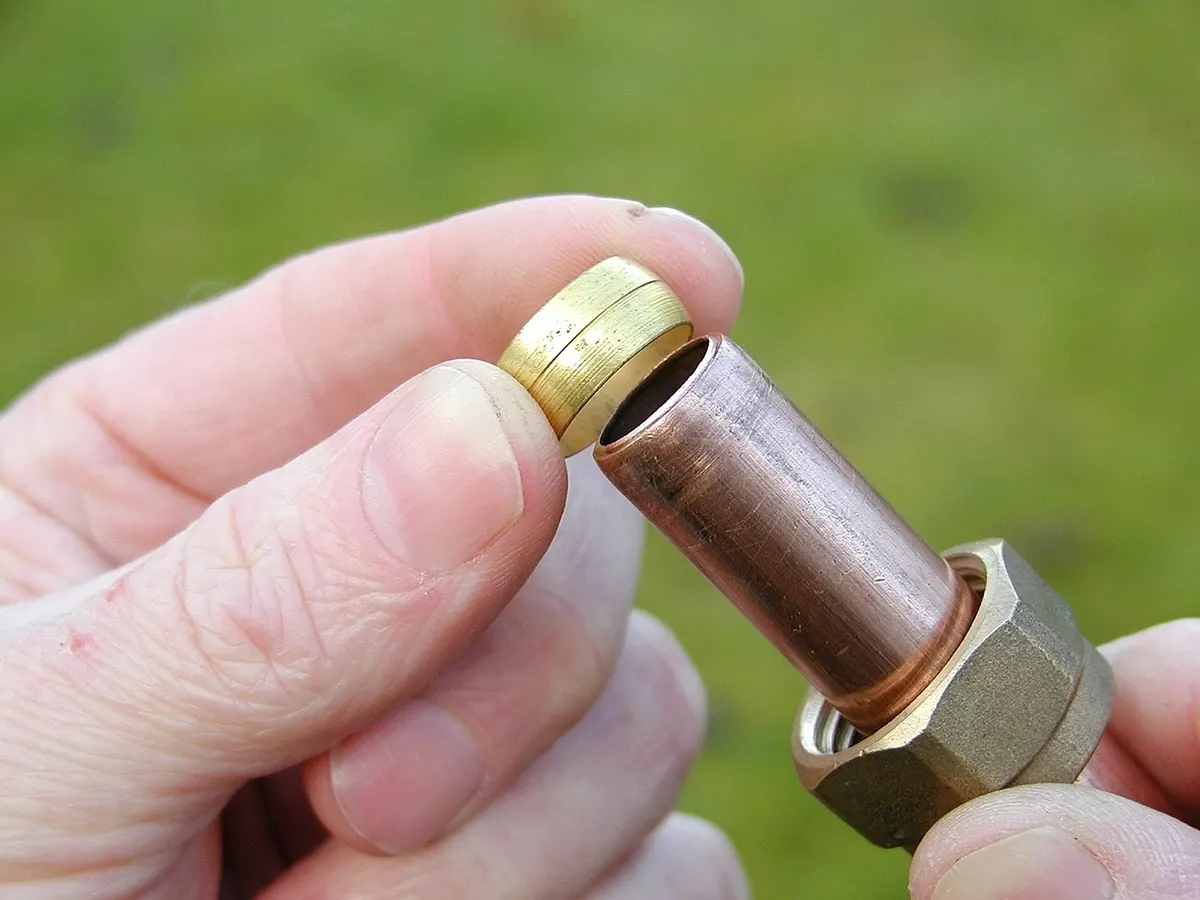
A compression fitting does the job with a nut and a soft copper olive. Slide the nut on, push the pipe into the body, tighten. No flame, no flux, no waiting. That makes them the right answer in lofts and cupboards where a blowtorch near timber would be reckless, and on older pipe that is slightly out of shape. The trade-offs are bulk and cost, plus one rule worth remembering: compression joints should stay accessible, so do not bury one under a floor or behind a sealed wall.
The fittings you will actually use
A small handful of shapes covers most jobs around the house:
- Straight coupler — joins two lengths of pipe in a line, also handy for repairing a damaged section.
- Elbow — turns a corner, usually 90 degrees. A bend does the same job with a gentler curve and less resistance to flow.
- Tee — branches off a run. Equal tees take the same size on all three legs; reduced tees step down, and 22mm to 15mm is a common combination.
- Reducer — steps pipe down in a straight line.
- Stop end — caps a dead leg, either temporarily while you work or permanently.
- Street elbow — an elbow with a male end that pushes straight into another fitting, useful in tight corners.
- MI (male iron) fitting — adapts copper to a threaded brass or iron connection, such as a tap tail or radiator valve.
- Tank connector — fixes pipe through the wall of a cistern or cylinder.
- Drain cock — a small valve for emptying a system.
- Isolating valve — lets you shut off one tap or appliance without draining everything down. Fit them where you can actually reach them.
One thing worth knowing: flexible tap connectors are not copper at all. They are braided hose with rubber inside, and they have a shorter working life than the pipe they join, so keep them where you can see them.
Where push-fit earns its place
Push-fit fittings, including all-metal copper push-fit types, grip the pipe with a collet and seal with an O-ring. They are quick, need no heat and can be removed with the right tool, which makes them useful for a fast repair or a joint in an awkward space. Two cautions. They should not be used where the pipe might be pulled or strained, and the seal depends on a rubber ring with a finite life, so keep them accessible. On plastic pipe you must use the correct insert; on copper, make sure the end is clean, square and free of burrs before pushing it home.
Getting a joint right
Most failures come down to preparation rather than technique. Work through these in order and you will rarely go wrong:
- Cut the pipe square. A pipe cutter gives a cleaner edge than a hacksaw; if you do use a saw, file the end flat afterwards.
- Ream the inside and file the outside edge so no burr is left to disturb the flow or nick an olive.
- Clean the pipe end back to bright copper with an abrasive strip or fine wire wool. Solder will not take to tarnished metal.
- Apply flux sparingly to the pipe end rather than down inside the fitting.
- Push the fitting fully home. Marking the pipe with a pencil first lets you confirm it has not shifted.
- Heat evenly around the fitting, keeping the flame moving. With solder ring fittings, stop as soon as the ring of solder shows at the mouth.
- Wipe the joint with a damp cloth while it is still hot. Flux residue is corrosive and will attack the pipe over time.
And if the pipe is wet, stop. Water pulls heat away from the joint and turns to steam, which will blow solder straight back out. Drain the section down first, or use a compression fitting instead.
Mistakes that cause drips
- Over-tightening a compression nut until the olive splits or the pipe crushes. Firm is enough.
- Reaching for PTFE tape on a weeping compression joint. The olive does the sealing; tape usually hides a damaged pipe or a badly seated olive.
- Mixing imperial and metric pipe and fittings because they look close enough.
- Leaving joints under floors or inside walls where nobody can get to them.
- Skipping pipe clips. Support runs at regular intervals and allow a little room for expansion on hot pipe, or you will hear ticking and rubbing for years.
- Running hot and cold pipes tight together, which warms the cold supply and encourages condensation.
Your starting kit, and when to call someone
For household work you can get a long way with 15mm and 22mm pipe cutters, a deburring tool or half-round file, an abrasive strip, flux, lead-free solder, a small gas torch, two adjustable spanners and a handful of spare couplers, stop ends and isolating valves. Buy one or two more fittings than you think you need; a second trip to the merchant costs more than the spare.
Anything connected to the mains supply needs to comply with the water fittings regulations, and if you are unsure about a job — particularly one involving a sealed heating system, a hot water cylinder, or anything at all involving gas — bring in a qualified plumber. Gas pipework in the UK must be worked on by a Gas Safe registered engineer. Knowing where your limit is makes you a better DIY plumber, not a worse one.
Photo: Eugene_Brennan / Pixabay